THE "FOUR PILLARS" HELPING TO DRIVE RANGERS PERFORMANCE TO A HIGHER LEVEL

It is widely regarded in high performance that there are "four pillars" of performance that link to enable a team to function at it it's best level, these being:
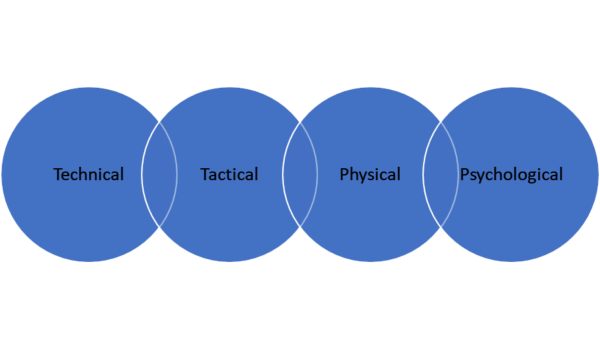
TECHNICAL: An individual players ability to carry out key skills to a high level under pressure. These skills include shooting, tackling, dribbling, passing, first touch/ball control.
TACTICAL: Both the coach/manager (in Derek McInnes's case manager) and players ability to have a strategic understanding of formations and team plans to maximise your own strengths and expose oppositions weaknesses. These skills include the ability to read a game as it unfolds and carrying out positional and unit discipline.
PHYSICAL:
Rangers players need to have the ability to recover as quickly as possible from physical exertions, the components of fitness are:
-Endurance: The ability to maintain exercise for as long as possible resisting fatigue.
-Speed: The ability to cover a distance in the minimum time.
-Strength: The ability to exert or resist forces.
-Power: (Speed x Strength) The ability to exert large forces quickly.
-Agility/Flexibility: The range of movement at a joint or range of joints. Greater flexibility enables better skill execution and a reduction in the likelihood of injury occurring.
PSYCHOLOGICAL (MENTAL): This involves how a player (and team) handles pressure and setbacks. Key components include motivation, confidence, resilience (handing mistakes maintaining discipline).
Outstanding All Blacks coach Sir Wayne Smith likened the "four pillars" to be legs of a stool, if any of these underperform then the stool becomes unsteady.
So how are Rangers doing against these "four pillars"?

TECHNICAL: Despite a poor start to the season resulting in being knocked out of two European competitions, it has been clearly evident following the Jablonec debacle in the Czech Republic, that the team has responded well with five wins (four SPL wins and the Premier Sports Quarter Final win over Celtic at Ibrox), scoring eight goals and only conceding one, an own goal versus Falkirk by Kosta Nedeljkovic.
With 14 new additions, Derek McInnes is now finding more consistency in selection, in particular with the summer transfer window closing, and this has led to players executing key skills to a high level.
There was evidence of this leading up to the Celtic Premier Sports Quarter Final match, but there were question marks whether this could be continued under the pressure of an old firm opponent who were unbeaten in the SPL.
The players responded with a strong display of technical skills being carried out to a high level.
TACTICAL:
Derek McInnes deserved immense credit to have the tactical acumen to deploy James Penrice as additional midfielder (left) to both support Dan Neil and Nico Raskin, and also to mark Benjamin Nygren. The knock on effect meant that Olwethu Makhanya had to marshal both the centre of defence and left back periodically, a task that he passed with flying colours.
This example shows that the manager had thought about negating potential threats (Nygren) and exposing opportunities (space outside the penalty area) that resulted in two opportunities for Dan Neil to score in both halves.
McInnes praised the players who had the tactical awareness to carry out a plan under the most extreme pressure.

PHYSICAL: There was alarming evidence of Rangers dropping off their performance in the second half of games last season.
This could have been as a result of having weak Psychological (mental) outlook, but is largely due to the pre-season conditioning that was undertaken.
The foundation of a teams fitness is fostered during pre-season and time enables this to be carried out in conjunction with skills work and unit/team play, once the season is underway fitness work is still carried out, but with the regularity of games (despite Rangers being out of European competition) an approach to maintenance is carried out alongside rest, recuperation and recovery strategies.
The pre-season planned for Russell Martin last year was designed for high possession rates would not have aligned to the requirements of his successor Danny Rohl's pressing approach, hence the drop off in performances in the latter stages of games. I used the analogy in a previous piece that Martin's pre-season's preparation would be like putting diesel into a Ferrari Dino sports car in relation to Rohl's demands. The engine would in a short time splutter, lose power and misfire. The result being that when physical fatigue sets in not only do physical attributes drop, but mental decision making is also prone to miscalculations.
The good news is that the pre-season set for season 2026-27 will be designed for McInnes's style of football and it's physical demands.
The work rate of the players in the Celtic Premier Sports Quarter Final was impressive, Penrice and Makhanya played the full 90 plus minutes both undertaking very physically demanding roles and still looking energetic at the end. Fernandez, Sterling and Raskin also fall into the category of carrying out 90 plus minute performances. In previous season's Sterling's minutes would have been abbreviated.
This greater level of conditioning should enable the Rangers players to play with greater effect for longer and reduce injury risks.

PSYCHOLOGICAL (MENTAL): Rangers teams have been labelled many things over the last few seasons with the word "mentality" being referenced again and again, maybe "lack of mentality" would be more appropriate.
There were fears that with six players not experiencing an old firm game that they may be "spooked" by the occasion, apprehension and anxiety vastly affects a players ability to function skills and think clearly. It seemed that the opposite was witnessed, the players (including the five other starters) relished the opportunity and embraced the challenge both individually and collectively as a team.
It is conceivable across several factors that this was the case to include:
-Despite the European setback, pre-Aberdeen the team spent time together and trashed out a few home truths.
-The original "Leadership Group" that clearly contributed to negativity in the playing environment and the dismissal of managers has been disbanded. (William references this in his piece of 17/09/2026 "The Leadership Group Has Been Replaced With A Team Together).
-As there are so many changes to the squad (14 in 14 out at the close of the summer transfer window), they are not scarred by previous failures, and the existing players can thrive on an opportunity to have a clean slate and be part of something positive.
-The playing environment has more "Rangers Men" within it to set standards, examples being McInnes, Shankland, McGregor, McCrorie and McAllister to name five.
-The board under Mr Cavenagh wanted to sign "leaders", and as each week passes despite the average age of the now 30 man squad being 24, these players are beginning to come to prominence whether on or off the field (Pandur, Makhanya, Penrice, Neil, Devlin, Dragojevic, Min-Su and Shankland). As alluded to above the existing players are also making strong contributions (Sterling, Fernandez, Raskin, Curtis, Gassama, and Naderi).
A concluding question: At the end of the season how important was Bojan Miovski's 91st winner v St Mirren at Ibrox, and how did this contribute to the psychological/mental being strengthened?
SUMMARY:
Being a young squad with an average age of 24 is going to show fluctuations in form both individually and collectively as a team, however the positive factor is that there is a lot of growth left in the squad.
There are positive signs that the "four pillars" of high performance are being carried out to a far higher level than that of previous years, and it can get better with patience and hard work.
I don't think anyone will be falling off that mythical four legged stool any time soon!!!
Marcus
HATW 1872


Comments